Kitchen Safety for Seniors: Modification Guide & Tips
A complete guide to kitchen safety for seniors with space modifications, cooking tips, and kitchen accident prevention.
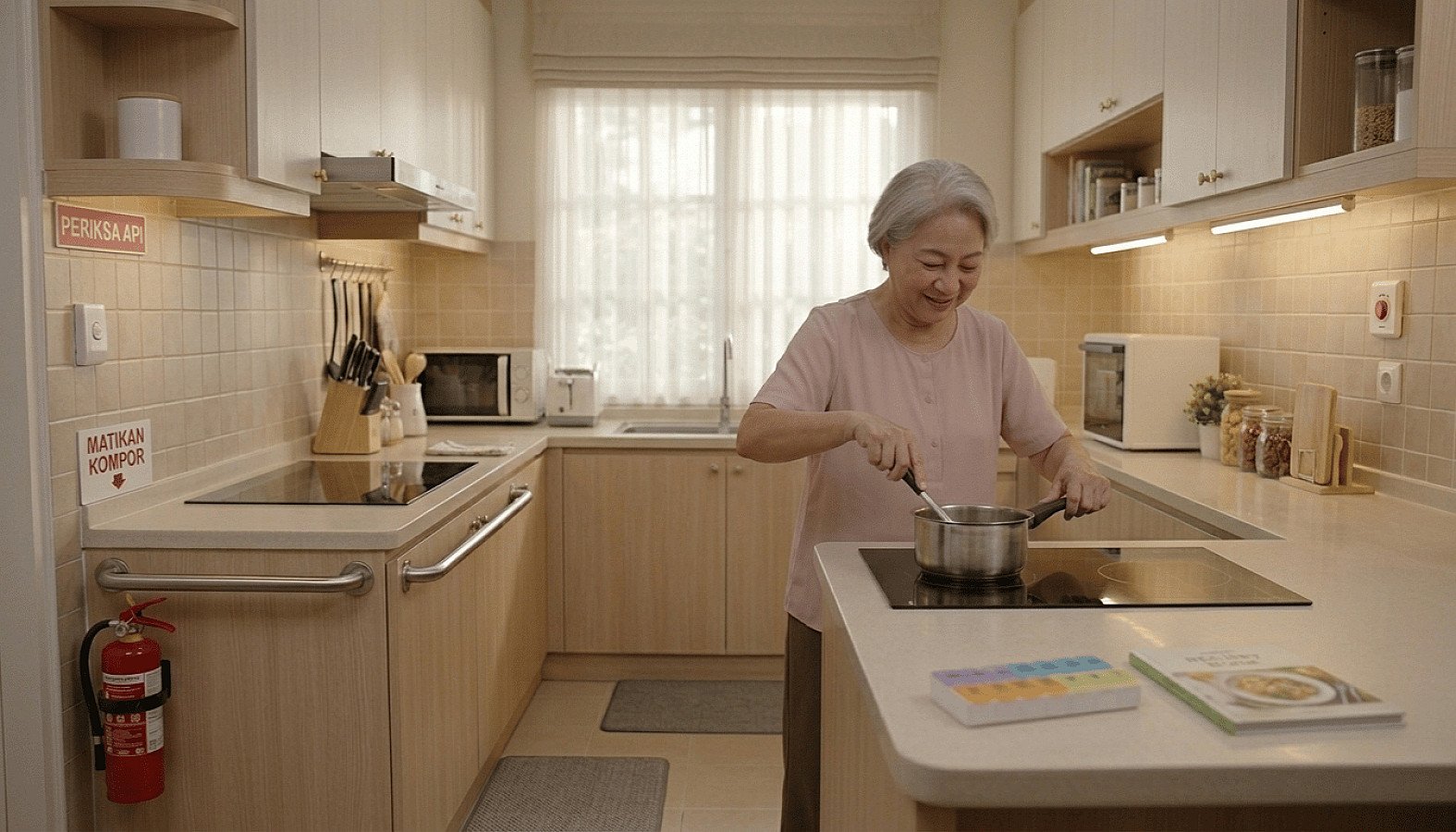
An elderly woman happily stirs a pot in a kitchen modified with grab bars and a fire extinguisher - RUKUN Home Care
The kitchen is one of the most dangerous areas of the home for seniors, with risks of fire, burns, slips, and injuries from sharp or heavy utensils. Many seniors in Bogor and Tangerang who still actively cook for themselves face additional challenges from decreased mobility, reduced vision, and slower reaction times. Kitchen fires account for more than 50% of home fires in seniors, while burns and cuts are the most common domestic injuries. However, with proper modifications and consistent implementation of safety practices, seniors can continue to enjoy cooking safely and independently. Creating an accessible kitchen environment and implementing safer cooking strategies can dramatically reduce the risk of accidents while maintaining your parent's independence and quality of life.
Why Is the Kitchen a High-Risk Area for Seniors?
Understanding the specific hazards present in the kitchen helps us design more effective prevention strategies. The kitchen presents a unique combination of risks not found in other areas of the home, requiring special attention in safety planning.
Fire and Burn Hazards
Fire and heat are the most serious threats in the kitchen, especially for seniors who may have slower reaction times or cognitive impairments that cause them to forget to turn off the stove. The consequences of a kitchen fire can be deadly and can often be prevented with proper modifications and precautions.
- Unattended gas stoves: Seniors with dementia or memory impairment may forget that they are cooking and leave the stove on unattended. Leaking gas is also a hazard if the stove is not lit properly.
- Flammable clothing: Loose or long sleeves can get caught in the stove flame or hit a pan of hot liquid, causing serious burns. Older adults with reduced vision may not realize how close their clothing is to the flame.
- Overheated cooking oil: Frying is the most risky cooking method for fires. Overheated oil can ignite in seconds, and many older adults don't know how to properly extinguish a grease fire (never with water).
- Towels and flammable materials near the stove: Placing kitchen towels, napkins, or food packaging too close to the stove is a common fire hazard that is often overlooked.
- Microwaves and ovens: Using non-microwave-safe containers or setting the oven to the wrong temperature can cause a fire or explosion. Older adults may have difficulty reading instructions or controls properly.
Risk of Falls and Physical Injury
Slippery kitchen floors from spills, disorganized utensils, and the need to reach or bend create numerous opportunities for falls and other injuries. The combination of hard surfaces and sharp utensils makes falls in the kitchen especially dangerous.
Spills of water, oil, or food make ceramic or tile floors very slippery. Poorly installed rugs or mats can fold and become tripping hazards. Opening heavy refrigerator or oven doors requires good balance and can cause seniors to stumble backward. Reaching for items on high shelves or bending to reach for pans in lower cabinets increases the risk of losing balance, especially for seniors with arthritis or back problems.
What Kitchen Modifications Improve Safety?
Physical kitchen modifications can significantly reduce the risk of accidents while making cooking easier and more enjoyable. Investing in these modifications pays off in the form of longer independence and a lower risk of injury.
Ergonomic Layout and Height
Kitchen design that takes into account the physical limitations of older adults makes cooking safer and less tiring. Universal design principles not only benefit older adults but also make the kitchen more user-friendly for all users.
- Adjustable Counter Heights: Standard counter heights (85-90 cm) may be too high for older adults using wheelchairs or too low for taller individuals. Consider a lower counter area (75-80 cm) for seated food preparation.
- Knee space under the counter: Create at least one open area under the counter (at least 70 cm wide x 75 cm high x 45 cm deep) so that seniors can sit in a chair or wheelchair while preparing food.
- Stovetop with front controls: Stovetops with control knobs on the front or side are safer than those on the back because seniors don't have to reach over a hot pan to adjust the temperature.
- Wall oven or oven drawer: A wall-mounted oven at waist height eliminates the need to bend over to load or remove food, reducing the risk of burns and falls.
- Dishwasher drawer-style: Dishwasher models with pull-out drawers are more accessible than standard front-loading models that require a lower bend.
- Refrigerator with Bottom freezer: This configuration places the most frequently used items (the refrigerator compartment) at a height that's easier to reach without bending or reaching too high.
- Sink that's not too deep: A sink with a depth of 15-18 cm is more ergonomic than a standard 20-25 cm sink, reducing strain on the back and shoulders when washing dishes.
Accessible Storage and Organization
A well-designed storage system ensures frequently used items are easily accessible without reaching, bending, or climbing. Efficient organization also reduces search time, reducing fatigue and frustration.
- Pull-out shelves and drawers: Replace static closet shelves with pull-out shelves or drawer organizers that bring items to the front for easy access. This eliminates the need to reach behind dark cabinets where items are hidden.
- Lazy Susan for corner cabinets: The swivel mechanism in corner cabinets makes all items easily accessible without having to reach deep into hard-to-reach corners.
- Store frequently used items at eye level: Dishes, glasses, condiments, and other everyday items should be stored between waist and eye level (75-150 cm from the floor) to minimize the need to reach or bend.
- Clear storage containers with large labels: Use transparent or translucent containers with very clear labels and large fonts to easily identify the contents without having to open or lower the container.
- Pegboard or magnetic strips for tools: Hang spatulas, spoons, and other cooking utensils on a pegboard or magnetic strip on the wall within easy reach rather than storing them in drawers that require bending.
- Avoid overcrowding in overhead cabinets. Height: If possible, eliminate or limit the use of cabinets above 170 cm. If unavoidable, store only rarely used items on high shelves.
Lighting and Visibility
Superior kitchen lighting is one of the most cost-effective yet impactful modifications for senior safety. Adequate light helps you see clearly when cutting, read labels, and identify spills before they become a hazard.
- General lighting of at least 500 lux: Kitchens require brighter lighting than other rooms. Use a combination of ceiling lights and recessed lighting for even light distribution without dark shadows.
- Task lighting for work areas: Install under-cabinet lighting under upper cabinets to illuminate counters and cutting boards with bright, shadow-free light. LED strip lights are an energy-efficient and long-lasting option. Lighting in cabinets and pantries: Motion-sensor LED lights in cabinets and pantries automatically turn on when the door is opened, making it easier to see what's inside without fumbling in the dark. Color contrast for safety: Use a counter color that contrasts with the floor and wall color to help seniors with low vision distinguish surfaces. Cutting boards in a different color than the counter also help with visibility. Minimize glare: Use diffusers or lamp shades to prevent direct glare, which can cause seniors to lose their vision after exposure to bright light. Matte finishes for counters and backsplashes reduce distracting reflections.
How to Use Kitchen Equipment Safely?
Selecting the right equipment and using it correctly is just as important as modifying the kitchen. Modern appliances with added safety features and safe usage techniques can prevent most kitchen accidents.
Appliances with Safety Features
Modern technology offers a variety of appliances with safety features specifically designed for elderly users or those with cognitive impairments. Investing in these appliances can prevent serious accidents and provide peace of mind for families.
- Induction cooktop with auto shut-off: Induction cooktops are safer than gas or electric coil cooktops because the surface doesn't heat up without a compatible pan. The auto shut-off feature turns off the cooktop after a specified period of time or if no movement is detected in the kitchen.
- Electric kettle with automatic shut-off: A kettle that automatically shuts off after the water boils prevents the water from evaporating and burning the kettle. Models with a cordless base are easier and safer to pour.
- Microwave with preset programs: A microwave with one-touch buttons for popcorn, defrosting, or reheating reduces confusion about time and power levels. The large, high-contrast display is easier to read.
- Slow cooker or instant pot: These appliances are safer than stovetop cooking because the temperature is lower and they are enclosed, reducing the risk of spills or burns. Many models have timers and an automatic keep-warm function.
- Toaster ovens with visual timers: Toaster ovens with clear timers and loud bells ensure seniors don't forget to remove food and reduce the risk of fire.
- Blenders or food processors with safety locks: Models with safety lock mechanisms that won't operate unless the lid is properly closed prevent injury from rotating blades.
- Fire suppression systems for stovetops: Automatic systems that detect excessive temperatures and automatically spray suppression agent to extinguish a fire before it develops are a worthwhile investment for maximum safety.
Safe Cooking Practices
Even with the best equipment, safe cooking techniques and consistent habits are key to preventing accidents. Caregivers can help reinforce these practices and provide supervision when needed.
- Never leave the stove unattended: This is the number one rule of kitchen safety. If you must leave the kitchen, even briefly, turn off the stove. Use a portable timer to remind you to return to the kitchen.
- Wear appropriate clothing: Avoid loose or long sleeves when cooking. Wear an apron and tie back long hair. Avoid flammable materials like nylon or polyester near the flame.
- Use the back burner more often: The back burner is harder for visiting children to reach and reduces the risk of accidentally touching hot pots or bumping into pot handles.
- Turn pot handles inward: Always turn pot and pan handles inward toward the stovetop, not outward where they can easily be bumped or grabbed by small children.
- Use dry mitts or holders: Wet mitts or pot holders can conduct heat and cause burns. Always make sure to dry your hands before handling hot items.
- Open lids away from yourself: When opening the lid of a hot pot or container, open it from the side away from your face to avoid hot steam, which can cause burns.
- Use a stable cutting board: Place a damp towel or non-slip mat under the cutting board to prevent it from sliding while cutting. Use a sharp knife—dull knives require more pressure and are more likely to slip.
- Clean up spills immediately: Wipe up spills immediately to prevent slippery floors. Keep paper towels or cloths within easy reach for quick cleanup.
Managing Pans, Heavy Utensils, and Hot Liquids
Lifting and moving heavy or hot items is one of the riskiest kitchen activities for older adults. Strategies to reduce this risk include modifying techniques and using assistive devices.
- Use smaller, lighter pans: Lightweight aluminum or stainless steel pans are easier to lift than heavy cast iron ones. A pot with two handles on each side is more stable to lift than a single handle.
- Fill the pot on the stove, not in the sink: Instead of filling a large pot with water in the sink and carrying it to the stove (risking spills and heavy weight), place the pot on the stove first and fill it with water using a pitcher or kettle.
- Use a cart to move heavy items: A rolling cart or trolley can be used to move heavy items or multiple dishes from the counter to the dining table without having to lift and carry.
- Drain pasta or vegetables in the sink: Instead of lifting a heavy pot of boiling water to the sink, use a spider strainer or slotted spoon to lift the pasta or vegetables from the water, or place a colander in the sink first and slowly pour from a low height.
- Let the item cool before moving: If it's not urgent, let the pot or casserole dish cool for a few minutes before moving it to reduce the risk of burns if it spills or spills. untouched.
What is the Role of Caregivers and Family in Kitchen Safety?
Families and professional caregivers play a crucial role in ensuring older adults can cook safely or supporting them with safe alternatives if independent cooking is no longer feasible. A balanced approach to independence and safety requires good communication and an honest evaluation of the older adult's abilities.
Cooking Ability Evaluation
Not all older adults have the same ability to cook safely. Regular evaluations help identify when more supervision or assistance is needed, or when it's time to transition to safer alternatives.
- Signs of unsafe cooking: Burned or scorched pans, stovetops or ovens that are forgotten to be turned off, confusion about how to use familiar appliances, or consistently raw or overcooked food can indicate safety issues.
- Assessment by an occupational therapist: An occupational therapist can conduct a comprehensive kitchen safety assessment, identify specific risks, and recommend appropriate modifications or adaptive equipment.
- Supervised trial: If there are safety concerns, try a trial period where a caregiver or family member observes the senior cooking to identify any difficulties or unsafe practices.
- Consider cognitive level: Seniors with early-stage dementia may still be able to cook with supervision, but those in the middle to late stages are usually unsafe to cook alone due to the risk of forgetfulness and poor judgment.
- Balance independence and safety: The goal is to maximize independence while minimizing risk. This may mean the older adult can perform simple meal preparation but requires assistance with high-heat cooking.
Caregiver Support in Kitchen Activities
Professional caregivers from services like RUKUN Home Care can provide varying levels of support depending on the older adult's needs and abilities. This caregiver support can light supervision the cooking process.
- Supervision while cooking: For seniors who can still cook but need reminders, caregivers can be present in the kitchen to ensure the stove is turned off, timers are set, and safety practices are followed.
- Cleaning and sanitation: Ensuring the kitchen is clean and organized reduces the risk of food contamination and slipping on spills. Caregivers can assist with cleaning tasks that require bending or reaching.
- Continuing safety education: Caregivers can gently remind the elderly of safety practices and encourage safer habits without appearing to criticize or take away their autonomy.
Alternatives to Traditional Cooking
When traditional cooking is no longer safe or feasible, alternatives can ensure seniors continue to receive good nutrition without safety risks. The transition to these alternatives must be done sensitively to respect seniors' feelings and independence.
- Meal delivery services: Meal delivery services that provide pre-prepared meals or meal kits with simple instructions can be a solution for seniors who still want to be involved in meal preparation with minimal risk.
- No-cook or minimal-cook meals: Focus on meals that don't require cooking, such as salads, sandwiches, yogurt with granola, or smoothies. Use pre-cooked proteins like rotisserie chicken or canned tuna.
- Microwave-only kitchen setup: For some seniors, a kitchen setup that uses only a microwave and no stovetop can be a safe compromise. Many meals can be prepared in a microwave, which carries a much lower risk.
- Family meal rotation: Family members can take turns preparing meals or bringing food to seniors several times a week, reducing the frequency with which seniors need to cook for themselves.
Next Steps: Create a Safe Kitchen for Your Parent
Kitchen safety is an important investment in your parent's health and independence. With thoughtful modifications, the right equipment, and appropriate support, many seniors can continue to enjoy cooking safely for longer. Start with a thorough evaluation of the current kitchen, identify the most pressing hazards, and implement modifications gradually based on priorities and budget.
If you need professional caregiver for your parent's, contact us at RUKUN Home Care is ready to help. Our caregivers are trained in kitchen safety, meal preparation for special dietary needs, and can provide varying levels of support from light supervision to complete meal preparation. Visit assessment for a free consultation about your senior's kitchen safety and cooking support needs, or contact us via WhatsApp at RUKUN Home Care for more information about our services.
Disclaimer: This article is educational in nature and provides general guidance on kitchen safety for seniors. Every home and senior has unique needs based on kitchen layout, physical and cognitive abilities, and level of independence. For significant structural modifications, consult a licensed contractor or kitchen designer who specializes in universal design or aging-in-place modifications. For seniors with complex health conditions or cognitive impairments, consult an occupational therapist for a professional kitchen safety assessment. Decisions about a senior's ability to cook safely should be made in collaboration with healthcare professionals, family, and the senior whenever possible. Information about appliances and adaptive equipment in this article does not constitute an endorsement of specific products. For further guidance on kitchen safety or professional caregiver services that can help with meal preparation, visit FAQ or contact the RUKUN Home Care team for a personal consultation.
Induction cooktops are the safest choice for elderly who can still cook independently due to several safety advantages. First, induction surfaces don't become hot themselves—only compatible pans heat up, so risk of burns from accidentally touching cooktop surface is greatly reduced. Second, no open flame or glowing red elements that can accidentally ignite flammable materials. Third, many modern induction cooktops have auto shut-off features that turn off cooktop after certain time without pan or if temperature too high. Fourth, digital controls are usually more precise and easier to read than analog dials. Fifth, flat surface is easy to clean without gaps where food can get trapped. However, there is learning curve as induction works differently from traditional stoves, and requires compatible cookware (stainless steel or cast iron with magnetic base). For elderly with significant cognitive impairment, even induction cooktops may not be safe without supervision. Safer alternative is portable induction burner that can be stored and only brought out when used with supervision, or transition to safer cooking methods like slow cookers, instant pots, or microwave only.
Forgetting to turn off stove is serious safety problem requiring multiple layers of intervention. First, install stove or oven with automatic shut-off timer that turns off appliance after certain duration (usually 1-2 hours for oven, 30 minutes for stove). Second, use kitchen timer with loud alarm and visual alert that can be carried anywhere in house to remind elderly to return to kitchen. Some modern timers can even connect with family smartphones for remote notifications. Third, post large checklist with very clear font on kitchen exit door reminding to check stove, oven, and other appliances before leaving kitchen. Fourth, create consistent routine—for example, always set timer when starting to cook and don't leave kitchen until timer sounds and appliance is turned off. Fifth, consider smart home technology like smart plugs or stove guards that can detect excessive use or can be turned off remotely by family. Sixth, for elderly with dementia or significant memory impairment, supervision by caregiver or family member during cooking may be only truly safe solution. Lastly, if forgetting to turn off stove becomes persistent and dangerous problem, may be time to consider transition to safer cooking alternatives or complete meal preparation by caregiver.
Several most impactful kitchen modifications don't require major renovations or high costs. First and most important is improving lighting—add under-cabinet LED strip lights (Rp 200,000-500,000), upgrade to brighter LED bulbs in existing fixtures (Rp 50,000-150,000 per bulb), and add motion-sensor night lights (Rp 100,000-300,000 each) for safe night visibility. Total lighting investment may be only Rp 500,000-1 million but provides very large safety improvement. Second, organization and accessibility—install pull-out shelves or drawer organizers (Rp 200,000-500,000 per unit), lazy susan for corner cabinets (Rp 150,000-400,000), and pegboard or magnetic strips for hanging tools (Rp 100,000-300,000). Third, anti-slip flooring—add anti-slip treatment to existing ceramic floors (Rp 100,000-300,000 for small area) or replace with anti-slip mats in high-risk areas like in front of sink and stove (Rp 150,000-400,000 per mat). Fourth, strategic grab bars—install grab bars or handrails in transition areas or near heavy appliances like refrigerator (Rp 300,000-800,000 per bar installed). Fifth, safety equipment—keep easily accessible fire extinguisher (Rp 300,000-600,000) and install additional smoke detector in or near kitchen (Rp 200,000-500,000). Total for basic safety modifications can range Rp 2-5 million which is much cheaper than cost of treating injuries from kitchen accidents.
Elderly with arthritis, neuropathy, or hand dexterity problems can use kitchen tools safely if using adaptive equipment and proper techniques. First, use knives with ergonomic handles that are thicker and easier to grip—some models have rubber grips more comfortable for arthritic hands. Paradoxically, very sharp knives are actually safer because they require less pressure and are less likely to slip than dull knives. Second, use cutting boards with safety features like non-slip side on bottom and spikes or grippers on top that hold food in stable position when cutting. Third, consider adaptive tools like rocker knives operated with rocking motion rather than sawing motion, or electric knives for tasks requiring much cutting. Fourth, food processors or choppers can replace most hand chopping for elderly with very reduced grip strength. Fifth, electric can openers or those with ergonomic handles are much easier than traditional manual can openers. Sixth, jar openers or gripper pads can help open tight containers. Seventh, safe techniques like claw grip (fingers folded inward like claw) when holding food to be cut protects fingertips. Lastly, if arthritis is very severe or significant tremors make knife use dangerous, pre-cut vegetables and prepared ingredients can reduce or eliminate need for risky knife work.
This is very difficult and emotional decision because cooking is often important aspect of elderly identity and independence. No one-size-fits-all answer, but several red flags indicating cooking alone is no longer safe include: multiple episodes where stove or oven left on, physical evidence like pots that are charred or burned found regularly, confusion about how to use previously familiar appliances, repeated injuries like burns or cuts from knives, significant deterioration in meal quality showing confusion or skill loss, or elderly themselves expressing fear or anxiety about cooking. For elderly with dementia, disease stage is important consideration—early-stage dementia may still be safe with supervision, but moderate to severe dementia generally unsafe for cooking without constant supervision. Best approach is gradual transition rather than sudden prohibition: start with supervision by caregiver, then transition to elderly helping with preparation while caregiver does cooking, then caregiver doing all cooking but involving elderly by choosing menus and sitting in kitchen for company. Frame conversation not as taking away independence but as ensuring safety: 'We want to make sure you are safe and not hurt, so we will help with cooking now.' Involve elderly in decision process and give them other ways to contribute like planning meals or setting table.